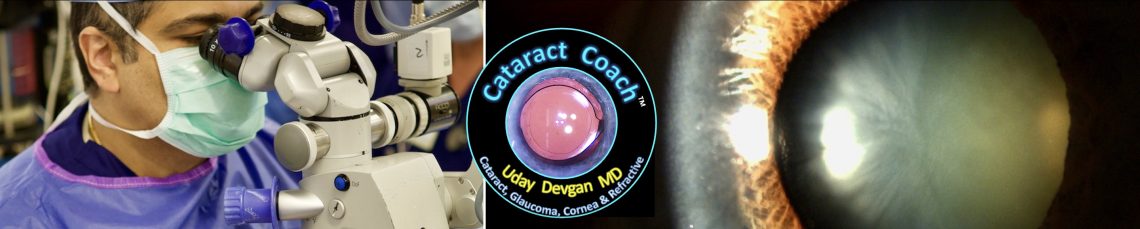


Approaching cataract surgery in a dense white cataract with a fibrotic anterior capsule presents significant challenges that require careful planning and refined technique. The first critical step is achieving a controlled capsulorhexis. In these cases, the fibrotic capsule may be leathery, non-elastic, and resistant to tearing, making a continuous curvilinear capsulorhexis technically difficult. Staining the capsule with trypan blue under an air bubble significantly enhances visualization. A sharp cystotome or micro-scissors can be used to initiate the capsulorhexis, especially if the fibrotic plaque resists standard tearing techniques. If the capsule remains difficult to manipulate, microcapsulorhexis forceps provide better control to complete a well-centered, round opening.
Once capsular access is achieved, care must be taken during hydrodissection. In mature white cataracts, intralenticular pressure is often elevated due to liquefied cortex (the so-called “Argentinian flag sign” risk). To avoid capsular blowout, decompress the lens gradually by aspirating some of the liquefied cortex before full hydrodissection, using minimal fluid injection and observing for fluid wave movement. The dense nucleus often necessitates a mechanical chopping technique such as vertical chop, minimizing ultrasound energy and limiting stress on the zonules. Dense plaques may also be adherent to the posterior capsule and require careful polishing or viscodissection. Throughout the case, the use of dispersive OVDs and meticulous fluidics control is essential to protect the corneal endothelium and maintain intraocular stability.
This is a complete cataract case performed by me and shown start to finish without edits.
