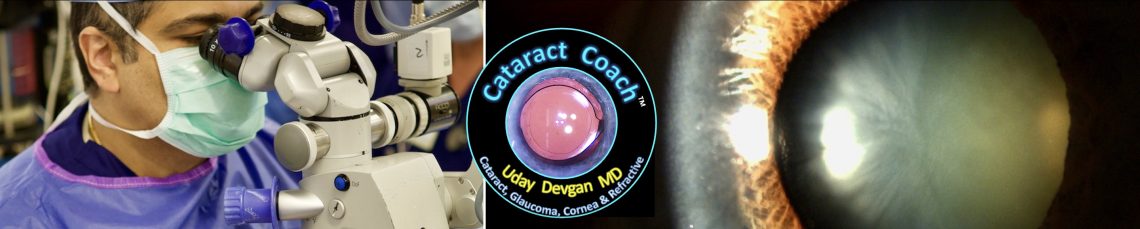


Head positioning and exposure of the surgical field is important for success in phacoemulsification. The patient should be supine with the head positioned so that the iris is parallel to the floor. Then the eyelashes should be draped out of the way and a speculum placed to spread the eyelids. The palpebral fissure between the eyelids is determined by patient anatomy but also by the level of patient cooperation. If the patient is uncooperative and is actively squeezing the eyelids then the palpebral fissure will narrow and the Bell’s phenomenon will cause the globe to move to upgaze.
The solution is for the anesthesiologist to give the patient additional intra-venous sedation in the form of a short-acting benzodiazepine like midazolam. Calming the patient with reassurance can also be helpful, as can turning down the intensity of the microscope lights.
Click below to where we highlight the importance of surgical exposure:

Uday,
Do you routinely tape the patient’s head to immobilize it during routine clear corneal temporal Phaco surgery (assuming there is no head tremor due to Parkinson’s Disease, etc.)?
Do you think taping the head is considered to be “The Standard of Care” for ALL surgeons performing Cataract Surgery on ALL patients, when performing routine clear corneal Phaco temporally? Personally. I never do, except in rare circumstances as mentioned above. This has been my routine since completing my Fellowship at MEEI/Harvard Medical School in 1986.
I do all my surgeries at A freestanding ambulatory eye surgery center on Long Island with six rooms functioning at all times, with an anesthesiologist in the room with the surgeon at all times, to provide sedation if needed. We perform approximately 20,000 cases per year.
We use the striker on our tables that start in an upright sitting position in the pre-op area that comes equipped with a donut shaped indentation to keep the patient’s head stable. Once the patient is put into the OR, the back of the Stryker “chair” is lowered to convert it into a flat OR table.
There is also a flexible “swan“ device that elevate the sterile drape off the patient’s face, so the patient does that feel claustrophobia, and it is connected to oxygen to create an oxygen tent for the patient. Do you routinely tape every patient’s head prior to cataract surgery, and if you do, do you think that all surgeons should do this to all patients prior to starting surgery, or do you think that it should be left up to the discretion of what the surgeon feels is best for each individual patient?
Thanks.
Up to the surgeon.