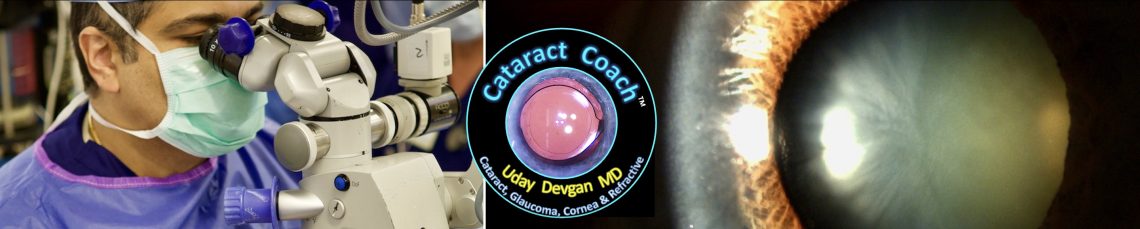


3083: And then you see the lens equator!

Directly visualizing the lens equator within the pupillary aperture during cataract surgery signifies severe zonulopathy and some degree of cataract subluxation. When significant zonular loss occurs, the lens shifts away from the area of missing support, exposing the bare equatorial edge and creating a challenging surgical environment with heightened risk for capsular collapse, vitreous prolapse, and posterior lens dislocation. Managing this case safely hinges on stabilizing the capsular bag early using flexible capsular hooks around the anterior rhexis rim and extending to the capsular bag equator, before initiating nuclear disassembly, as well as avoiding forceful hydrodissection or excessive rotational movements that could stress remaining intact zonules. Watch the video to see how this subluxated lens is stabilized and successfully emulsified while preserving capsular integrity. What is your threshold for using capsular hooks or inserting a capsular tension segment when you visualize an exposed lens equator during surgery? Please comment your thoughts below.
also remember these guidelines for area of zonular loss:
- 1 clock hour of zonular loss: no CTR required, just place IOL haptic in the bag against the area of zonulopathy to act as a bolster
- 2 to 3 clock hours of zonular loss: CTR is required, but no scleral suture fixation is usually needed
- 4 to 6 clock hours of zonular loss: CTR plus 1 sutured CTS; or Cionni ring
- 7 or more clock hours of zonular loss: CTR plus 2 sutured CTS; or double Cionni ring
