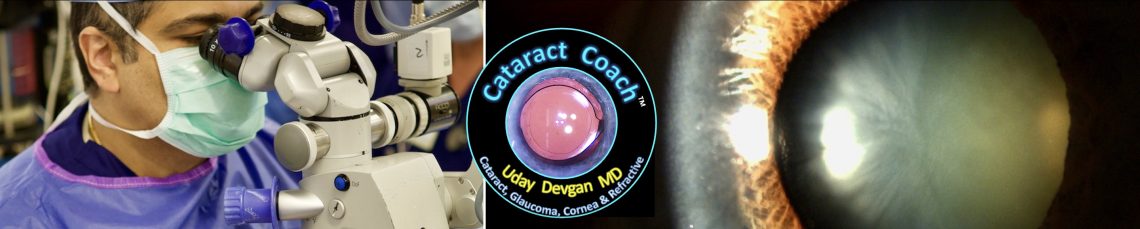


I am very proud of this resident for sending in this video of case 75, which is quite challenging, with the goal of learning how to become better. Fantastic and that approach will make you into a master surgeon in the future. My most important message in this case is that you do not need to suffer. With a patient moving so much, go ahead and augment the anesthesia by switching from topical to a block (sub-tenon’s, peri-bulbar, retro-bulbar, whatever you want). Also address the small pupil by using iris hooks, a pupil ring, or even perform pupil stretching. This is a great learning opportunity for beginning surgeons and we encourage your helpful comments as well. Here is a list of the challenges from the anonymous resident surgeon:
- Very dense red cataract
- Surgery performed under topical anesthesia, with a poorly cooperative patient
- Shallow anterior chamber
- During hydrodissection the canula was not primed and an air bubble went behind the lens
- Initially mid-dilated pupil that progressively became poorly dilated during sculpting
- We started with lower phaco power, but the nucleus was denser than anticipated.
- No pupil expansion device was available.
- The implanted IOL had a pointed leading haptic, and during manipulation the patient experienced significant pain and moved his head
- During removal of the last nuclear fragment, I iatrogenically touched the iris with the phaco probe, resulting in mild iris atrophy
What is your best advice for learning? Please comment below.
