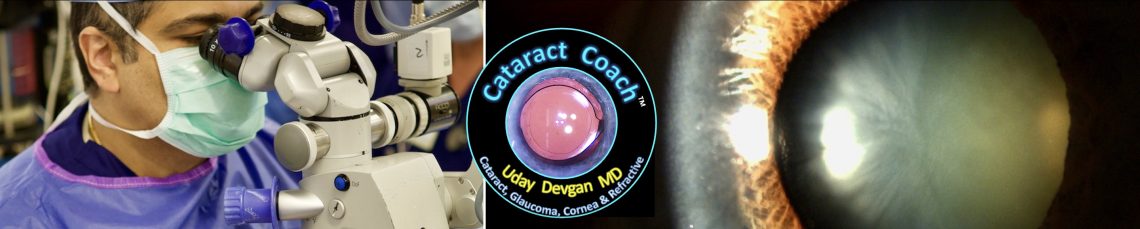


We need your help. With the collective minds and experience of thousands of ophthalmologists, I trust that we can solve this mystery case. This patient presents to our guest surgeon with acute bilateral white cataracts, bilateral corneal edema, and bilateral hypotony. Here is a summary. Please read carefully and leave your comments below so we can solve this mystery together!
Summary of Key Clinical Features
Demographics/History:
- 49-year-old female
- History of keratoconus
- Systemic illness: compensated Primary Biliary Cirrhosis (on Urosfalk + carvedilol)
- History of unsupervised/off-label IV treatments via alternative medicine
Sequence of Events:
- Prescribed dex/levo eye drops for 4 weeks pre-ICRS
- Sudden bilateral vision loss, pain, and photophobia
- Exam: bilateral acute intumescent cataracts, shallow AC, hypotony, corneal edema
- B-scan: clear vitreous; UBM: phacomorphic-like, no CB rotation
- Intense fibrinous reaction → resolved with oral (not topical) steroids
- Cataract surgery performed with difficult view, rhexis extension, but normal IOL position
- Persistent hypotony, corneal edema, photophobia postop
Differential Diagnosis & Pathophysiological Considerations
1. Idiosyncratic reaction to topical steroids
- The rapid and severe fibrin reaction to topical steroids (yet resolution with systemic steroids) is highly unusual.
- Idiosyncratic steroid reactions usually manifest as:
- IOP elevation
- Rarely as inflammatory reactions due to vehicle/preservative (e.g., BAK, phosphate buffer)
- The lack of inflammation postoperatively on oral steroids argues against classic autoimmune uveitis, but supports a toxic or hypersensitivity etiology.
2. Toxic anterior segment syndrome (TASS)-like phenomenon
- The bilateral, synchronous, rapid course, and significant fibrin, corneal edema, hypotony, and pain raise suspicion for a TASS-like event.
- However, this predated surgery and was not associated with intraocular procedure.
- Possibly triggered by:
- Prolonged use of topical dex/levo – especially if containing phosphate-buffered dexamethasone (phosphate may chelate calcium and cause calcific deposits/toxicity)
- Unregulated IV medications from homeopathy clinics – unknown toxicity or immune-mediated response
3. Bilateral phacomorphic response without uveal effusion or CB rotation
- Rare, but the intumescent lens picture suggests osmotic swelling of the lens, possibly due to:
- Metabolic derangement (PBC-related, or from toxic exposure)
- Steroid-induced metabolic lens changes (unusual, but theoretically plausible)
- Subacute lens protein alteration → secondary inflammation/hypotony
4. Ciliary body shutdown / toxic cyclitis
- Explains persistent hypotony even after IOL placement and deep AC
- Supported by:
- Poor IOP recovery postop
- No apparent leakage or overt inflammation
- Possibly sterile inflammation of CB due to systemic or topical insult
5. Corneal decompensation – endothelial insult
- Given pre-existing keratoconus, the endothelium may be functionally marginal.
- Toxic injury to endothelium from:
- Topical medications
- Surgical trauma unlikely (no phaco, minimal power)
- Inflammatory milieu / cytokine storm effect
- Persistent edema one week post-op, with Descemet’s folds, is concerning for irreversible damage
Investigative Pathways
- Specular Microscopy (if possible) – assess endothelial cell count and morphology
- Anterior Segment OCT – to evaluate Descemet’s, corneal thickness, iris/CB configuration
- Repeat UBM – to assess ciliary body function/atrophy or detachment
- Aqueous Tap for Cytology/Culture – especially if any suspicion of infection or retained toxin
- Toxicology / Immunology Workup – for unusual serum metabolites or circulating toxins
Working Hypothesis
This appears to be a bilateral toxic anterior segment insult, likely multifactorial, with key contributors being:
- Prolonged topical dexamethasone-phosphate (±preservatives) causing:
- Endothelial toxicity
- Possible sterile anterior uveitis-like reaction
- Idiosyncratic or hypersensitivity reaction to topical medications (or even vehicle components)
- Unregulated systemic therapies (IV substances from homeopathic clinic) leading to:
- Lens osmotic changes (intumescence)
- Possible immune dysregulation
- Ciliary body suppression
Management Thoughts & Prognosis
Short-term:
- Continue systemic corticosteroids – appears more effective than topical
- Carefully titrate topical steroids – right eye trial reasonable
- Aggressive hypertonic saline, Muro 128, and aqueous suppressants if IOP begins to rise
- Consider temporary intracameral viscoelastic if hypotony severe/persistent
Long-term:
- If endothelial function does not recover → DMEK or DSAEK consideration
- Monitor closely for chronic hypotony maculopathy, optic nerve damage
- Evaluate ocular surface and lacrimal function – chronic inflammation may unmask severe dry eye
Final Thoughts
This is a uniquely complex case with overlapping iatrogenic, inflammatory, and possibly toxic-metabolic components. A central mechanism seems to be bilateral anterior segment toxicity—possibly drug-induced—with associated ciliary body dysfunction and endothelial compromise. The precise trigger may never be identified, but the interplay between unregulated systemic treatments, topical steroids, and pre-existing ocular pathology (keratoconus) likely set the stage.

I believe snake venom can cause hypotony, endothelial cell damage and cataract