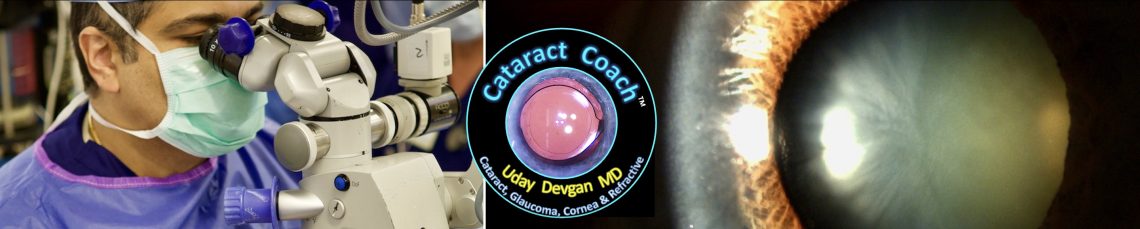


We all love performing cataract surgery on average eyes because we know what to expect: an average IOL power, average dilation, average nuclear density, average AC depth, and more. A large, myopic eye has some challenges but at least there is plenty of room within the deep anterior chamber. These tiny nanophthalmic eyes prove to have most challenges: a shallow anterior chamber, poor dilation, and a very high power IOL with uncertain IOL calculations. This patient also has glaucoma, a prior peripheral iridectomy, and a dense cataract. This is certainly a 10/10 challenging case. Our guest surgeon does a great job with this tough case. What are your pearls in these nanophthalmic eyes? Please comment below.

In eyes this small I would make my pars plana entry more anterior….about 2-2.5mm back from the limbus and angle down toward the optic nerve away from the lens. I always use Mannitol for eyes under 21mm and usually can avoid a PPV but not always. I’d also consider a scleral window and since you already have the port in I’d do IZHV (iridozonulohyloidovitrectomy) to create a unicameral eye and prevent aqueous misdirection. Finally if I am going to use a single piece lens I’d make a scleral tunnel on the steep axis to place the lens as this will avoid astigmatism and be more secure. In this case you’ve already taken conj. down for the PPV (which can be done transconj without peritomy) so at that point you might as well make a scleral tunnel and consider a scleral window. It would be interesting to know how this patient did and if there was any issue with aqueous misdirection.