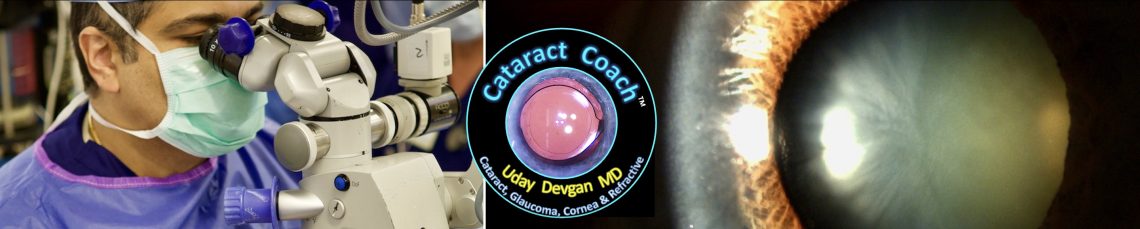


A Morgagnian cataract (named after Giovanni Morgagni the Italian father of anatomic pathology from the 1700s!) represents a very late stage of cortical cataract progression, where the lens cortex completely liquefies into a milky white fluid. This transformation allows the dense, brownish-yellow nucleus to sink inferiorly within the capsular bag due to gravity.
The primary surgical challenge, however, is the nearly universal presence of profound zonulopathy. As the lens becomes hypermature, it undergoes significant fluctuations in volume and protein leakage, which place chronic mechanical stress on the zonular fibers. These fibers often become stretched, brittle, or completely dehisced.
Surgical Management of Zonular Instability
- Capsulorhexis: The high intracapsular pressure makes the “Argentinian Flag Sign” a constant threat. Decompressing the bag with a needle before completing the rhexis is vital.
- Capsular Support: Because the bag lacks structural integrity, the early use of Capsular Tension Rings (CTR) or segments is often necessary to center the complex and prevent intraoperative collapse.
- Phacoemulsification: Without zonular counter-traction, the nucleus remains mobile and difficult to engage. Surgeons must rely on “slow-motion” phaco techniques and heavy dispersive viscoelastics to protect the corneal endothelium and the posterior capsule.
But in this case there is a further challenge: once the CTR goes in, it ends up disappearing!
