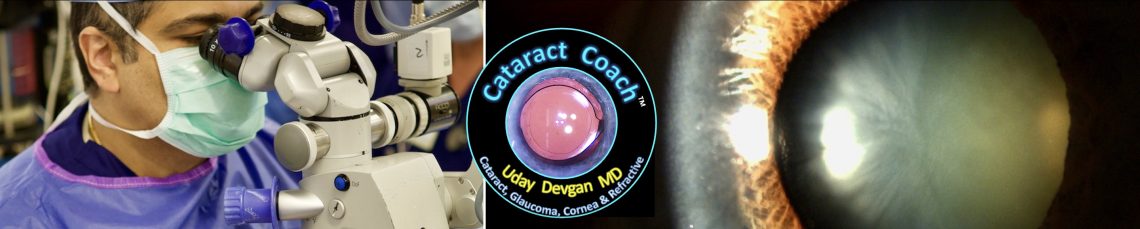


Performing a lensectomy in this 5-month-old infant with congenital cataracts requires meticulous planning and execution, as both the surgical technique and refractive considerations differ significantly from adult cases. The procedure is typically performed under general anesthesia. A limbal or pars plicata approach may be used, depending on surgeon preference, but many favor a limbal approach to allow better control and visualization. After creating a the incisions, a continuous curvilinear capsulorhexis (CCC) is attempted, although in infants the anterior capsule is elastic and prone to radial tears. If necessary, a vitrectorhexis technique using a high-speed vitrector is employed for both anterior and posterior capsulotomies. Lens aspiration is performed with a bimanual technique, carefully avoiding traction on the capsule-zonule complex. Given the high risk of posterior capsular opacification in pediatric patients, and particularly in this case where there is a posterior capsule plaque, a primary posterior capsulotomy and limited anterior vitrectomy are routinely performed to maintain a clear visual axis.
Choosing the intraocular lens (IOL) power in infants is particularly challenging due to ongoing axial growth and refractive changes. Biometry measurements, including axial length and keratometry, are obtained preoperatively under anesthesia. Surgeons typically aim for undercorrection to account for the myopic shift that occurs as the eye grows; a common approach is to target a postoperative hyperopia of approximately +6 diopters in infants under 6 months. Long-term follow-up is essential to monitor refractive changes, amblyopia risk, and to manage visual rehabilitation. To learn more about these cases, please refer to our prior podcast with Professor Ken Nischal here: https://cataractcoach.com/2025/05/25/2575-podcast-113-ken-nischal-md/
